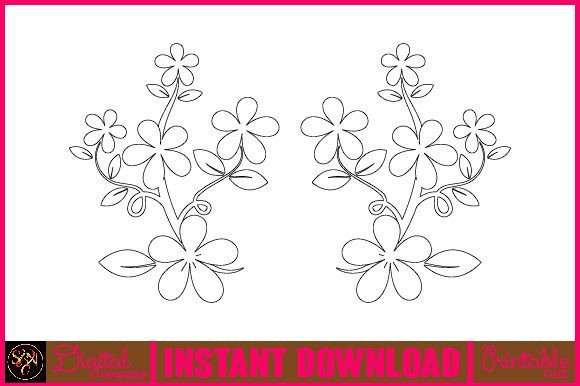
Floral Line Art Flower SVG Elements 89
A Designer’s First Look: Delicate, Not Dainty
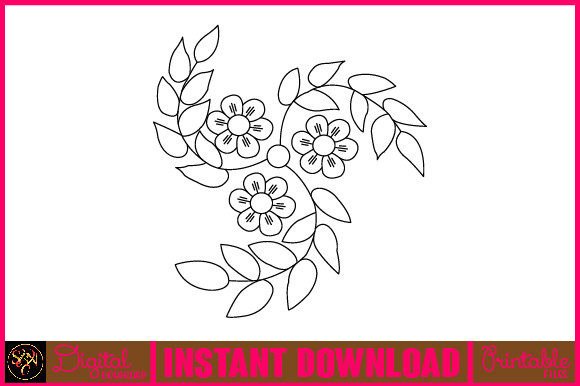
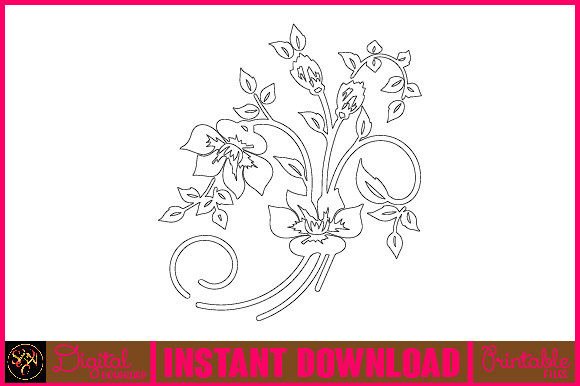
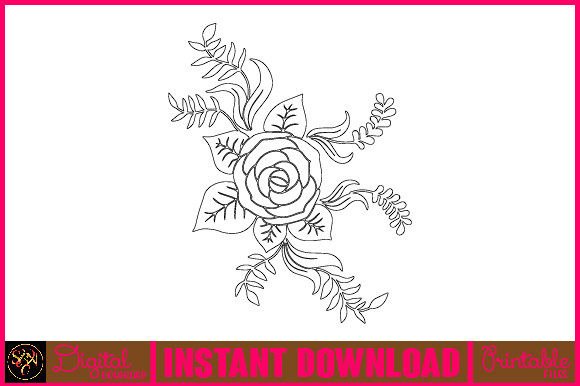
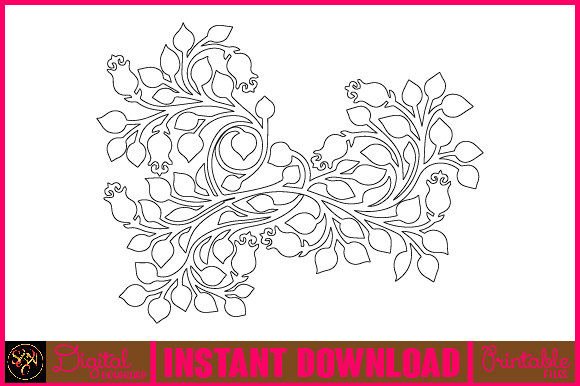
Opening Floral Line Art Flower SVG Elements 89, I immediately felt its quiet confidence — not fussy, not overworked, but intentionally spare. This isn’t a dense botanical print meant for wallpaper; it’s a hand-drawn branch with soft curves, asymmetrical blooms, and open negative space that breathes. The line weight stays consistent across stems and petals, suggesting clean vector integrity — essential when scaling for embroidery. As a designer who regularly converts illustrations to machine embroidery designs, I appreciated how the flow of the branch naturally guides the eye without demanding heavy fill stitch or tight satin stitch corners. It feels like something you’d sketch in a notebook before stitching — honest, unhurried, and quietly sophisticated.
Where It Shines: Real Projects, Real Fabric
Last week, I used Floral Line Art Flower SVG Elements 89 to develop a custom embroidered tote bag for a local herbalist’s pop-up shop. We chose a natural canvas with visible weave — not the smoothest surface for fine line work — yet the design held up beautifully. Why? Because its simplicity avoids trapping thread in fabric texture. The open loops and uncluttered spacing let each stem and petal read clearly at 3.5" wide, even on a slightly uneven surface. I also tested it on a lightweight cotton sweatshirt — no puckering, no skipped stitches. That’s rare for freebie graphics, which often skimp on stitch logic. Here, the implied rhythm of the branch makes it ideal for curved surfaces like caps or pillow covers: you can crop just a 4-inch segment and it still feels intentional, not truncated.
It’s equally strong as a baby embroidery element. On a gauzy muslin swaddle, the lightness of the line art translated into gentle, non-overwhelming detail — perfect for nursery decor or personalized onesies where subtlety reads as care, not compromise. And for holiday embroidery? Think tea towels or linen napkins: stitch it in ecru thread on oatmeal linen, and it becomes heirloom-level quiet luxury — no glitter, no fuss, just warmth and craft.
Where to Pause — Not Every Surface Is Equal
Don’t assume Floral Line Art Flower SVG Elements 89 is universally forgiving. On dark, stretchy fabrics like charcoal jersey, fine lines can disappear unless you use high-contrast thread (think white or pale gold) and add a light tear-away stabilizer underneath. On thin fabrics — think voile or lightweight rayon — those delicate branch tips risk distortion if hoop tension is too aggressive. And while the design avoids tiny lettering or micro-details, the inner curve of a closed bloom *does* tighten near the center. If you’re planning a 2-inch hoop application on a curved cap front, zoom in and check whether that section holds shape after stitching — some digitizers might need to gently widen that curve to prevent thread crowding.
Also: avoid layering this over busy prints or textured knits without testing. Its strength lies in contrast and clarity — so pair it with solid, matte, or minimally textured backgrounds. On heavily brushed fleece or terry cloth, the line may visually “sink” unless you boost stitch density slightly or add a subtle outline.
What It Adds — Beyond the Thread
Using Floral Line Art Flower SVG Elements 89 elevates perceived value without raising production cost. Customers notice the intention behind negative space — it signals handmade thoughtfulness, not mass-produced clip art. For Etsy sellers and small shop owners, that translates directly to trust. A customer buying a personalized apron with this design doesn’t just see “flowers”; they sense curation, calm, and craftsmanship. It supports brand consistency for makers who lean into botanical, slow-living, or minimalist aesthetics — no rebranding needed, just thoughtful placement.
For digital product sellers, it’s versatile design assets: use one bloom as a standalone monogram accent, the full branch as a tote bag design, or isolate leaves for printable mockups. And because it’s rooted in hand-drawn authenticity, it photographs well — critical for social media previews, craft fair signage, or email campaigns. No over-editing required. What you digitize is what your customer recognizes.
Practical Notes from the Hoop
- Always test first — stitch a sample on scrap fabric matching your final project’s weight and stretch.
- Check thread color contrast — especially on mid-tone or dark fabrics. Light threads on light fabric can vanish; try a matte cotton or silk thread for soft definition.
- Review stitch density — this design leans toward running and satin stitch rather than dense fill, but verify your digitized version doesn’t compress delicate curves.
- Confirm hoop size early — the full branch spans comfortably in a 4x4 hoop, but cropping works beautifully for smaller applications like patches or cap fronts.
- Inspect small details — look closely at junctions where stems meet blooms. Clean vector paths usually digitize well, but always verify stitch continuity.
- Test black-and-white mockups — this design relies on shape and rhythm, not color. If it reads clearly in grayscale, you’ve got visual hierarchy locked in.
- Use proper stabilizer — light cutaway for stable wovens, tear-away for knits, and a light film for sheer fabrics.
- Confirm licensing — since it’s listed under Freebies and Graphics, double-check usage rights before selling finished products or bundling as digital embroidery files.
Final Thought: Quiet Confidence, Not Noise
Floral Line Art Flower SVG Elements 89 won’t shout. It doesn’t need to. In a market saturated with bold, maximalist embroidery files, its restraint is its strength — especially for makers building long-term brands, not just seasonal listings. It fits seamlessly into custom apparel, baby embroidery, holiday embroidery, and commercial embroidery projects where elegance lives in the pause between stitches. Use it thoughtfully, test it honestly, and let its hand-drawn honesty speak for your craft business — no embellishment required.